Streets and arcades
Shopping the grid, not confusing it with one mall
Bourke Street, the nineteenth-century arcades and the market edge are public shopping geography. Melbourne Central is a separate shopping centre. This guide keeps those facts apart.
Shopping in Melbourne’s centre is a stack of systems: a nineteenth-century arcade, a twentieth-century mall, a pedestrianised retail street, a market on the grid’s lip, and a thousand independent rooms that will not be on this page by name. The only way to write that stack honestly is to name the systems and refuse the store list.
Bourke Street and the retail spine
Bourke Street is the CBD’s everyday shopping street — department-store blocks, chain retail, and the Bourke Street Mall section that visitors meet as a pedestrian space between Swanston and Elizabeth Streets. Trams still matter here; PTV’s Free Tram Zone rules still matter the moment you ride beyond the published map. The mall is not a festival just because it is busy.
Collins Street holds a different retail temperature: older commercial buildings, arcades, and rooms that present as quieter. Little Collins and Flinders Lane hold smaller fashion and object shops in among offices. Those are patterns. Tenants move.
Arcades are buildings, not hashtags
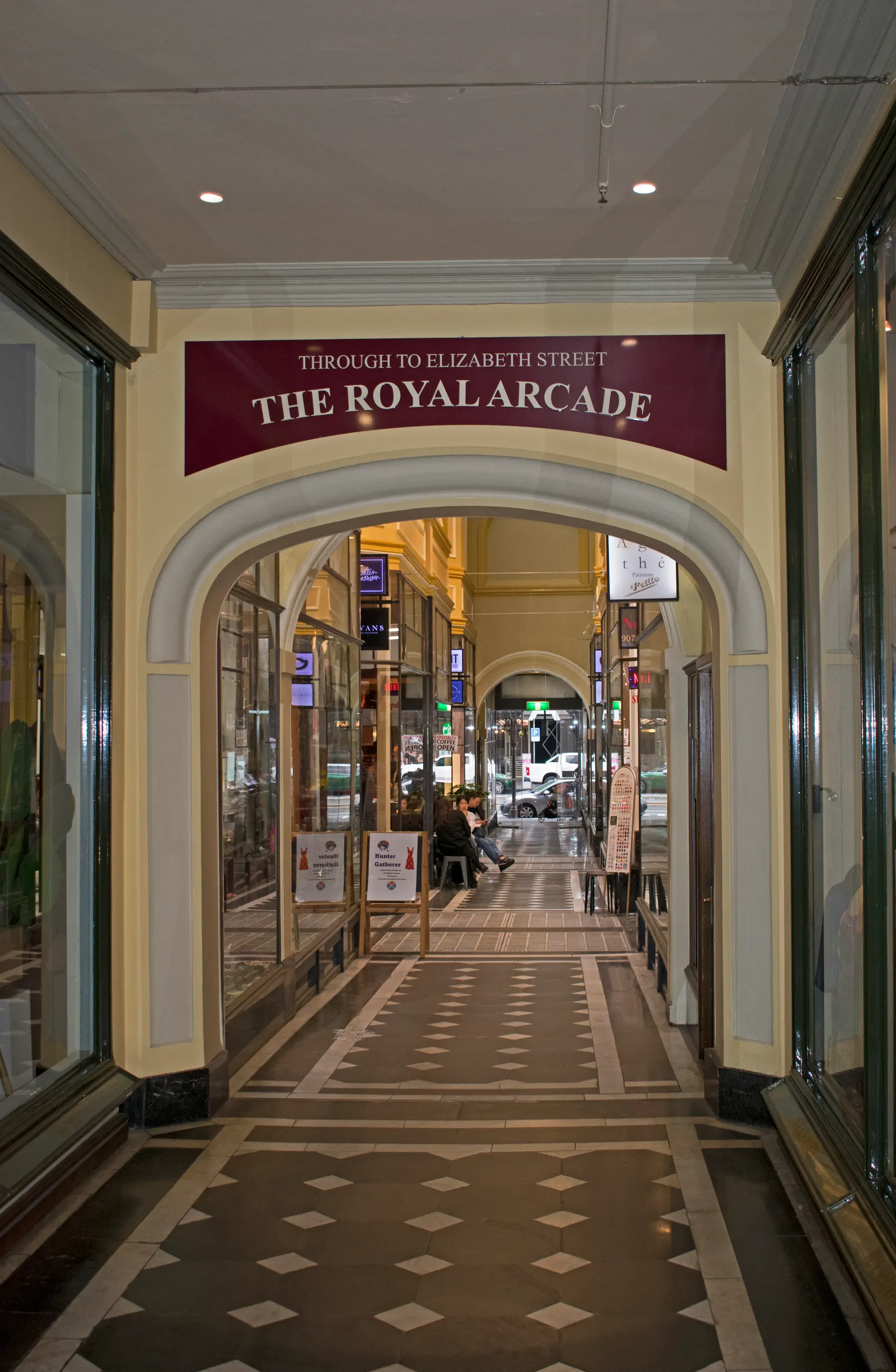
Royal Arcade is widely described as Australia’s oldest surviving shopping arcade, opened in 1870. The Block Arcade dates from the early 1890s and is known for its mosaic floors and glass canopies. Both are heritage places. Both contain shops that come and go. Photograph the fabric; check the shop.
Cathedral Arcade, inside the Nicholas Building on Swanston Street, is another covered interior visitors find when they walk between the station and the library. It is a building with tenants, not a secret level.
Malls, including the one this domain is not
Several large centres sit on or against the grid: Melbourne Central, Emporium, Queen Victoria Village, and others. Melbourne Central — corner of La Trobe and Swanston Streets, over a railway station — is the one people type into a search box when they mean this hostname. Their site is melbournecentral.com.au. Use it for that centre. Do not email this editor about a retailer on level three.
This independence is not hostility. It is anti-confusion. A visitor who thinks a town-name domain is a mall directory will miss the arcades, the market and the fact that half the CBD’s interesting retail is not inside a cone of glass.
Queen Victoria Market as shopping
Queen Victoria Market is shopping and food and civic habit. Days of trade, shed access and visitor conditions belong on the market’s site. Souvenir generalisations (“always open”, “best on Tuesday”) are how people arrive to shutters.
What you will not find here
- A coupon.
- A “top ten Australian designers” list.
- A reconstructed 2022 blog post about buying shoes or cargo pants. Those parked slugs redirect; their copy is gone.
- Trading-hour tables copied from a centre PDF.
If you need GST refunds, customs or postal rules, use Australian Border Force and the retailer, not a visitor guide.
A practical shopping half-day
Walk Bourke Street Mall for the wide public room, cut into Royal Arcade and across to Block Arcade, then decide whether you want a centre (their site, their hours) or the market (its site, its days). That sequence teaches the stack. It does not require this domain to pretend it has a live stock list.
For movement between those points, stay inside PTV’s Free Tram Zone if you want the published free tram condition — or tap as PTV requires the moment you leave it.
Department stores and the long retail block
Bourke Street’s department-store buildings are part of how Australians still picture “going into town”. Their ownership, concessions and floor layouts change. This guide will not name a current concession or a sale calendar. It will say: a department store is a useful indoor orientation device on a wet day, and it is still not the whole CBD.
Emporium and neighbouring centres plug into that Bourke / Lonsdale block. They have their own directories. Using them does not make this domain their customer-service desk.
Objects that are not fashion
Bookshops, stationers, music rooms and museum shops sit on the grid and just off it. The State Library shop, when the library is operating it, is a civic souvenir that is not a laneway brand. Gallery shops at NGV follow the gallery’s hours. None of these need a “hidden gem” caption.
Shipping, warranties and refunds
If you are taking goods out of Australia, the retailer’s policy and Australian Consumer Law are the useful texts. This site will not interpret a warranty. It will not guess a GST refund threshold. Border rules belong to Australian Border Force.
Sunday, public holidays, and the empty mall
Retail patterns on public holidays are not uniform. A centre may open while an arcade shop does not, or the reverse. Believe the door in front of you. A visitor blog that says “everything is open on Sunday” is not a source. The rainy-day note is the indoor plan when you do not want to gamble on a high street.
At a glance
- Bourke StreetThe main east–west retail street of the Hoddle Grid
- ArcadesRoyal Arcade (1870) and Block Arcade (1890s)
- Not the mallMelbourne Central is a distinct centre on La Trobe Street
What people always ask
Is this site the Melbourne Central shopping centre directory?
No. Melbourne Central is a separate retail and station complex. For its stores and hours, use the centre’s own website. This hub is about the wider CBD.
Where are Melbourne’s historic shopping arcades?
Royal Arcade opened in 1870 between Bourke and Little Collins Streets. The Block Arcade was built in the early 1890s around Collins and Elizabeth Streets. Confirm tenants on each arcade’s own channels.
Arcades are worth a slower walk
The covered nineteenth-century interiors are a different kind of shopping than a mall atrium. Read the arcade guide before you rush them.
Royal and Block Arcades