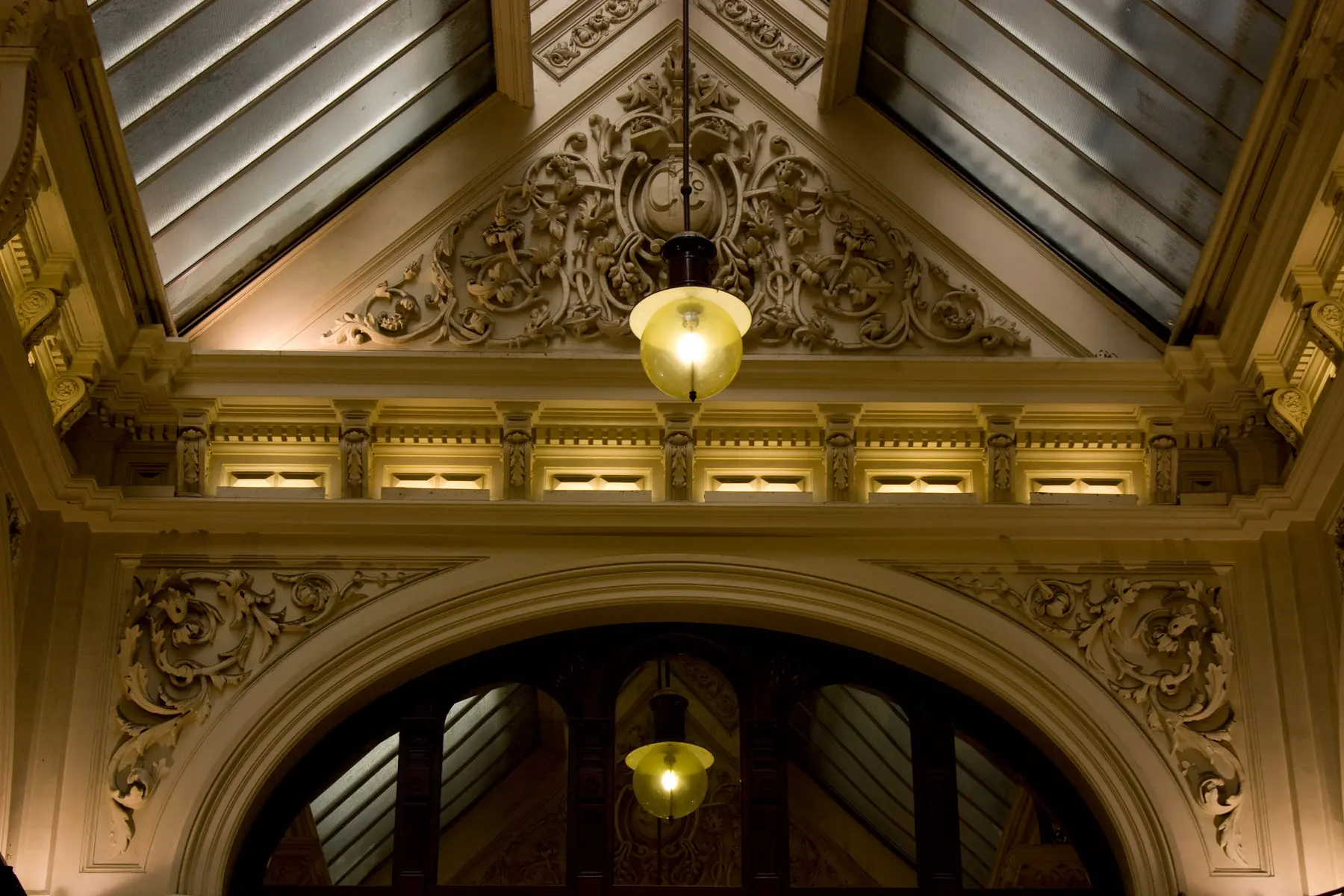
Heritage interiors
The arcades are the CBD’s covered streets
Royal Arcade opened in 1870. The Block Arcade followed in the early 1890s. Together they are the easiest way to understand that Melbourne’s centre had indoor shopping streets before it had glass malls.
Melbourne’s CBD is often sold as laneways. That story skips the arcades — purpose-built covered streets that let nineteenth-century shoppers move between Bourke, Collins and Little Collins without taking the weather. They are not malls in the postwar sense. They are not Hosier Lane with a roof. They are a third thing, and they repay a slower walk.
This guide covers the two visitors actually mean: Royal Arcade and the Block Arcade. It will not reconstruct a tenant directory. Shops leave. Mosaic floors stay.
Royal Arcade
Royal Arcade runs between Bourke Street and Little Collins Street, with a connection toward Elizabeth Street. It is widely described — including in heritage and arcade-published histories — as Australia’s oldest surviving shopping arcade, opened in 1870. That founding year is the kind of fact this site will repeat because it is stable and checkable. A list of current jewellers is not.
The interior is a long nave of small shops under a glazed roof. Figures associated with the arcade’s clock (Gog and Magog, in the arcade’s own storytelling) are part of how the building presents itself. Treat those figures as building furniture described by the arcade, not as a folk tale this guide invented.
Visit it as architecture first. If a shop is open and you want an object, that is a bonus, not the assignment.
The Block Arcade
The Block Arcade occupies a corner relationship with Collins Street and Elizabeth Street, with arms that make a folded walk rather than a single shot. Construction is dated to the early 1890s (commonly 1891–1893 in heritage summaries). The glass canopies and mosaic floors are the features people photograph; they are also the reason the arcade feels closer to a European galleria than to a strip mall.
“Doing the Block” is an older Melbourne phrase for promenading this part of Collins Street. You do not need the phrase to use the building. You do need not to block the mosaic with a tripod.
How they sit on a walking day
A clean sequence, which is geography rather than a copied civic tour:
- Enter Royal Arcade from Bourke Street Mall.
- Emerge on Little Collins and shift west or east toward Collins.
- Enter the Block Arcade from Collins or Elizabeth.
- If you still have attention, the Cathedral Arcade in the Nicholas Building on Swanston Street is a later, smaller covered interior on the walk between station and library.
That sequence teaches covered retail fabric. It does not require a coffee ranking at each end, though you will pass rooms that sell coffee. See eat and drink for why this site will not name them.
Heritage, maintenance, and closures
These are working heritage places. Floors get restored. Arms close for works. A wedding party or a filming permit can change the feel of an hour. None of that will be predicted here. If an entrance is taped, believe the tape.
Heritage listings and local planning controls sit with Victorian heritage authorities and with City of Melbourne as the local government. This guide is not the listing document. If you need the citation for a study, use the official heritage register search rather than a visitor paragraph.
Photography etiquette
Tripods in a narrow arcade at lunchtime are how visitors become infrastructure problems. Flash on mosaic can be unpleasant for people who work there every day. Shops may decline interior photography. Those are ordinary social rules, not a by-law this page invented.
Drone use inside or above the arcades is a bad idea and likely a prohibited one. Do not test that sentence.
What the malls took, and what they did not
Twentieth- and twenty-first-century centres — including Melbourne Central, which this domain is not — borrowed the idea of an indoor street and scaled it into atria and food courts. They did not replace the arcades. The arcades remain better at human width and worse at climate-controlled vastness. Use both if you want; do not let a centre directory (or a confused hostname) erase the older rooms.
If you came here looking for Melbourne Central store hours, leave this tab and use melbournecentral.com.au.
Nearby, without a shopping list
- Bourke Street Mall — the open-air retail room the Royal Arcade plugs into
- Collins Street — the Block’s frontage, with its own commercial history
- Flinders Lane — a longer street of buildings, not an arcade
- State Library Victoria — if you need a free indoor civic room after too much retail
Sources and humility
Opening years above follow commonly published arcade and heritage accounts. If a conservation report and a marketing site disagree by a year, prefer the statutory heritage record. Tenant names, trading hours and “best hot chocolate” claims are out of scope on purpose.
This page is longer than a postcard because the arcades are easy to rush. Rushing is how you see a ceiling in a phone preview and miss that you just walked a nineteenth-century street that still earns its keep.
How to enter without performing
Bourke Street Mall is loud. Royal Arcade is suddenly quieter. That acoustic change is part of the architecture. You do not need to whisper; you do need not to treat the nave as a runway. The same is true of the Block’s folded arms, where people already stop for photographs on the mosaic. Take the picture from the side. Let the axis remain a thoroughfare.
If you are meeting someone, a main-street entrance is kinder than a mid-arcade blockage. Collins Street and Bourke Street have sky. The arcade has a glass roof and a crowd.
Wayfinding, clocks, and the desire to invent lore
Visitor copy loves a legend. Gog and Magog, “doing the Block”, a particular tea room, a particular mosaic pattern — some of that is building-published history, some is marketing, some is memory. This guide’s rule is: if the arcade’s own current site or a heritage citation says it, you may lean on it; if a blog says it with a quote mark and no source, leave it. We will not invent a ghost.
Clocks and mechanical figures, where they operate, have hours that belong to the building. Do not plan a day around a performance this page cannot see.
Accessibility
Heritage interiors were not poured for modern access. Some arms have steps, thresholds or crowded widths. If you need a step-free route, look at the building’s current access note or ask on the day. This guide will not invent a lift that may not exist in a particular wing. The open mall and the newer centres are often easier; that is a fact about decades, not a ranking of taste.
Weather pairing
The arcades are the correct rainy-day retail walk. They are also useful in heat, because glass and stone still beat unshaded asphalt for a short crossing. They are not air-conditioned vastness. If someone in your group needs that, a centre — including Melbourne Central, which is not this site — is the honest tool.
Shopping without a directory
You may buy something. You may not. Either outcome is a complete visit. The architectural fact does not require a transaction. If you do buy, the retailer’s receipt is the document that matters for returns, not a paragraph on a visitor guide.
Parked slugs on this hostname that once pushed jewellery and shoe “reviews” are redirected. They were not arcade history.
A last contrast
Stand in Royal Arcade, then later stand in Hosier Lane. The first is a nineteenth-century indoor street that still sells things. The second is an outdoor service lane that still takes paint. Melbourne’s centre is both, and it is smaller than the mythology. You can do both in a day without a tour if you refuse to collect every named alley in between.
If you remember only one architectural fact, remember the years: Royal Arcade in 1870, the Block in the early 1890s. If you remember only one visitor fact, remember that both are public interiors with changing shops. Everything else — tea rooms, mosaics, clocks — is detail you can verify on the building’s own page when you care enough to stand still.
At a glance
- 1870Royal Arcade opens (widely cited founding year)
- 1890sBlock Arcade built after the 1891–93 works
- CoveredPublic interiors with shops that change
What people always ask
What are Melbourne’s historic shopping arcades?
Royal Arcade (opened 1870) and the Block Arcade (early 1890s) are the two best-known nineteenth-century shopping arcades in the Hoddle Grid. They are heritage buildings with changing tenants. Confirm shops and hours on each arcade’s own information.
Do I need a ticket to walk through?
No. They function as public retail interiors during the hours the buildings are open. Individual shops are ordinary businesses. This guide does not publish those hours.
Combine stone with paint
If you have already walked Hosier Lane, the arcades are the contrast that makes both spaces readable.
Hosier Lane